Free printable allergy symptom log
Write down how your allergies felt, when, and what you were around, so you don't have to rely on memory at your appointment. Made for adults with seasonal or indoor allergies.
No sign-up and no account. Print it in black and white and fill it in by hand. It's for recording what you notice, not a diagnostic tool.
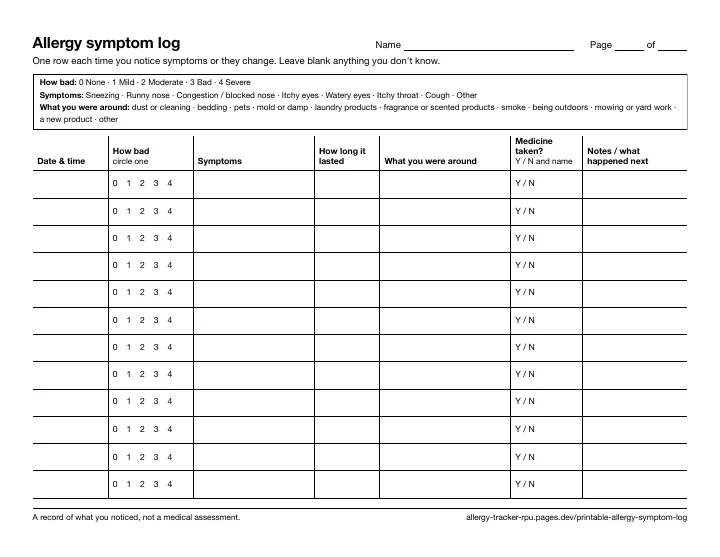
What's on the log
Two pages. Print as many copies of page 1 as you need, and a page 2 for each month.
Page 1: Daily log
Twelve rows, one for each time you notice symptoms or they change. Across the top is a short key for the severity scale, the symptoms, and things you might have been around.
- Date & time
- When you noticed symptoms, or when they changed.
- How bad
- Circle 0 None, 1 Mild, 2 Moderate, 3 Bad or 4 Severe. It's your own rating, not a clinical score.
- Symptoms
- Sneezing, runny nose, congestion or a blocked nose, itchy eyes, watery eyes, itchy throat, cough, or anything else.
- How long it lasted
- Minutes, hours, or "all day". A rough idea is fine.
- What you were around
- For example dust or cleaning, bedding, pets, mold or damp, laundry products, fragrance or scented products, smoke, being outdoors, mowing or yard work, or a new product. It's a note of what was around you, not proof that it caused anything.
- Medicine taken?
- Y or N, and the name if you know it.
- Notes / what happened next
- Anything else you want to remember.
Page 2: Month at a glance and appointment summary
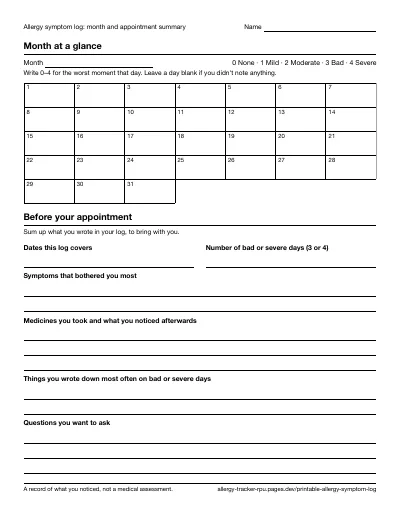
Month at a glance has 31 numbered boxes. Write 0–4 in each for the worst moment that day, so you can see the month on one page.
Before your appointment has space for:
- the dates your log covers
- the number of bad or severe days
- the symptoms that bothered you most
- medicines you took and what you noticed afterwards
- the things you wrote down most often on bad or severe days
- questions you want to ask
Page 2 only sums up what you wrote. It doesn't ask you to work out a cause.
How to fill it in
- Write a row when symptoms start or noticeably change. You don't need to fill in every hour.
- Use the same 0–4 scale each time, so a 3 means the same thing on Monday as it does on Friday.
- It's okay to fill in something you remember later. Put the time as best you can.
- Write down medicine when you take it: Y in the medicine column, and the name if you know it.
- At the end of the day, write that day's worst rating in the month grid on page 2 for a quick overview.
Taking it to your appointment
Bring your log pages and page 2. When you're asked how things have been, you'll have a written record of what you noticed instead of relying entirely on memory. Symptom diaries can help organize the details of your history for a clinician (American Academy of Family Physicians).
Your clinician, not the sheet, decides what your notes mean and what to do next. If you've been asked to keep a particular kind of record, follow those instructions.
What a symptom log can and can't show
A symptom log records your own observations: what you noticed, when, how bad it felt, and what you wrote down about it.
- It doesn't diagnose allergies.
- It doesn't show what caused your symptoms, even if something appears often in your notes.
- It doesn't replace testing. An allergist usually takes a medical history, examines you and, if needed, runs allergy tests (American College of Allergy, Asthma and Immunology). Testing and diagnosis belong to a doctor or allergist.
Is this the right log for you?
Food reactions
This printable is designed around seasonal and indoor allergy symptoms, like sneezing, a blocked nose and itchy eyes. It has no space for what you ate. If you want to write down reactions to food, use a food and symptoms diary instead, such as Allergy UK's food and symptoms diary.
Severe reactions
A severe allergic reaction (anaphylaxis) is a medical emergency: if you think you or someone else is having one, call your local emergency number, such as 911 in the US or 999 in the UK (NHS: Anaphylaxis).
Prefer to log on your iPhone?
Paper works, and this printable stays free. If you'd rather keep an ongoing log on your phone, Allergy Tracker for iPhone records the same kinds of things: how bad it is, symptoms, what you were around, medicine and notes. It keeps your history and shades a month calendar for you.
Logging, your history and the calendar are free. The doctor report PDF, CSV export and the 30-day summary come with Lifetime, a one-time purchase: US$19.99 in the US, and no subscription. What's included with Lifetime.
Questions
Is the printable free?
Yes. Both PDFs are free to download, print and copy for your own use. There's no email, sign-up or account.
Should I download Letter or A4?
Choose US Letter in the US and Canada, and A4 almost everywhere else, including the UK, Europe and Australia. If you're not sure, check the paper in your printer. Both files have the same two pages.
Can I fill it in on my phone?
It's made to print and fill in by hand, so the PDF isn't a fillable form. Some PDF apps let you write on top of a PDF, but the spaces are sized for pen and paper. If you'd rather log on your phone, see Allergy Tracker for iPhone above.
How long should I keep the log?
There's no single right length. How much history is useful for an appointment varies from person to person, so if your clinician has asked you to keep a log for a particular period, follow that. Otherwise, keep it until your appointment and bring every page.
Will this tell me what I'm allergic to?
No. The log is a record of what you noticed. It can't diagnose an allergy or show what caused your symptoms. Diagnosis and allergy testing belong to a doctor or allergist.
This printable is a place to write down what you notice. It doesn't diagnose, treat, or tell you what causes your allergies, and it isn't medical advice. Talk to a doctor, allergist or pharmacist about your symptoms and medicines.